
- Participation continues to contract. Volatility has normalized and the cost of protection has fallen.
That is not stability.
- It is an asymmetric market: the underlying weakness remains unresolved, but hedges are no longer pricing the same level of stress seen one week ago.
- The critical question is no longer whether the market is weak. It is whether this weakness will remain contained—or whether volatility and credit will begin confirming a broader repricing.
Market Regime: Withdrawal Keeps Going , Not Rotation
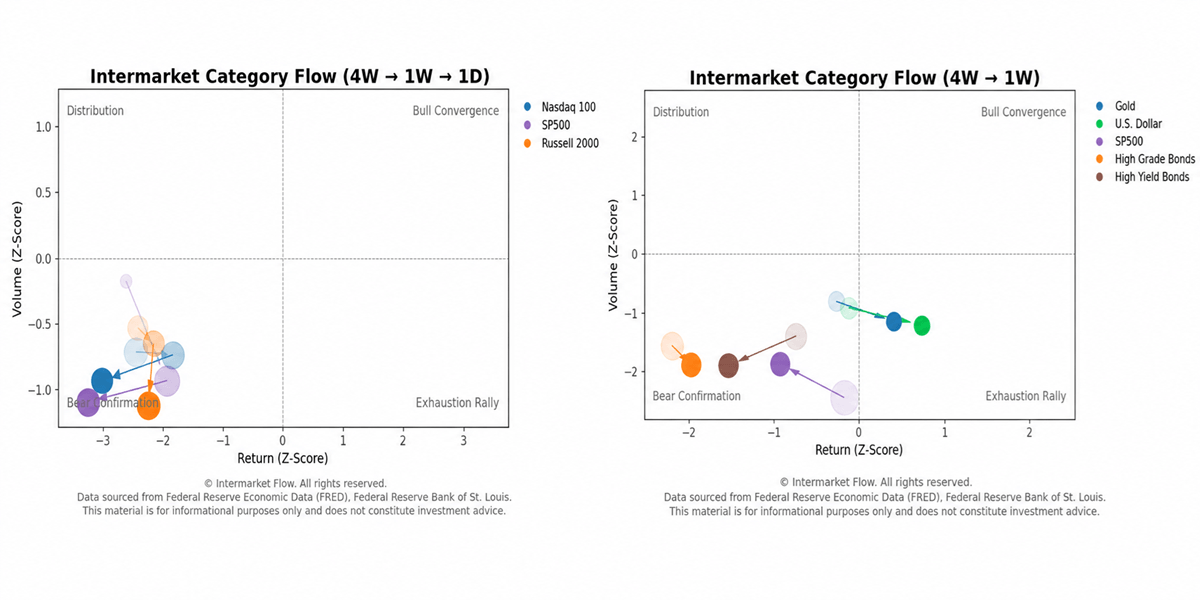
How to Read
- Axes X: Return Z-Score — price direction. Y: Volume Z-Score — market participation.
- Quadrants: Bull Convergence: Price up, volume up — confirmed strength. Distribution: Price down, volume up — active selling. Exhaustion Rally: Price up, volume down — unconfirmed rebound. Bear Confirmation: Price down, volume down — weakness without demand.
- Trajectory: Solid bubble = current reading. Faded bubble = previous reading. Arrows show the direction and magnitude of change.
- Bubble Size: Volume within each time window relative to its own historical average.
- Core Rule: Volume validates price. Below zero volume, price moves lack participation and remain vulnerable.
The Nasdaq 100, S&P 500 and Russell 2000
- Equities remain firmly inside Bear
- Confirmation, with returns approximately −2σ to −3σ below normal across the monthly, weekly and daily time frames.
- Volume is also below normal, though less extreme, creating a persistent low-liquidity bleed rather than a single capitulation event.
- This four-week bearish convergence loop—lower returns accompanied by lower volume—shows continued price weakness, contracting participation and no evidence of accumulation.
- Technical Analysis View: From a pure technical perspective, equities are currently in a confirmed downtrend.
Invalidation: The bearish structure should only begin to lose relevance if weekly volume rises to at least +1σ above normal, providing the first credible sign of renewed participation.
Credit-U.S. Dollar and Gold (left chart) reinforces the diagnosis
- Investment Grade carries the deepest absolute weakness.
- High Yield shows the sharper recent deterioration.
- The U.S. dollar remains the strongest relative defensive asset.
- Gold is also resilient. But neither has sufficient volume confirmation to validate a broad defensive rotation.
It is not conventional Risk-Off.It is Hands-Off. What had previously been a defining feature of bonds has now spread to equities as well.
No Phase of the Economic Cycle Is Being Confirmed
Each macro synthetic groups assets that should strengthen under a specific phase of the economic cycle.
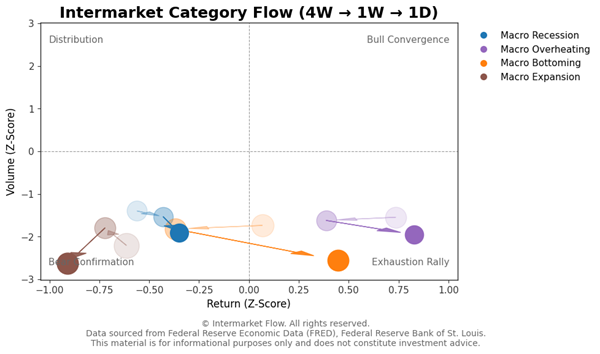
- Macro Expansion remains in Bear Confirmation.
- Macro Recession also lacks participation.
- Macro Overheating preserves positive returns, but volume is declining.
- Macro Bottoming improves in price while participation contracts sharply.
Macro Overheating and Macro Bottoming—the two least-weak baskets—are two sides of the same coin. Both reflect a market in transition, but neither has volume behind the move.
Lack of participation is not the absence of a decision. It is the decision.
This transitional structure explains why seemingly contradictory groups can rise during the same week—for example, both Consumer Staples and Consumer Discretionary. Without meaningful volume behind either move, the market is not confirming a coherent macro regime; it is producing fragmented, low-conviction price action.
Volatility: The Risk Has Not Disappeared—Its Price Has
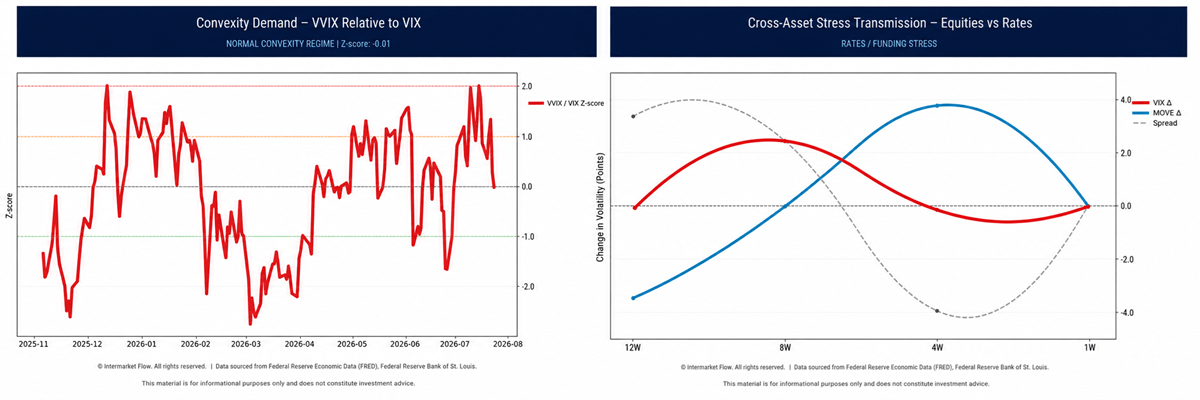
- At 4W, rates volatility was the dominant source of stress (left). MOVE remained elevated while VIX was already close to neutral (left chart).
- At 1W, both have returned toward zero. The cross-asset volatility impulse has faded.
- The expensive convexity (right chart) observed last week has also normalized. VVIX has adjusted toward realized equity volatility, while the VVIX/VIX Z-score has returned to approximately zero.
Hedges are cheap again.This creates the report’s central asymmetry:
- Market participation remains weak, but protection has repriced before market depth has recovered.
- The absence of volatility expansion is not evidence that the risk has disappeared. In a liquidity vacuum, volatility can remain compressed until a catalyst forces the entire structure to adjust at once.
Vehicle Selection: Where the Regime Is Clearest
Once market regime, macro structure and volatility align, the strongest expressions become identifiable.
Russell 2000: the weakest equity vehicle and the clearest expression of small-cap fragility.
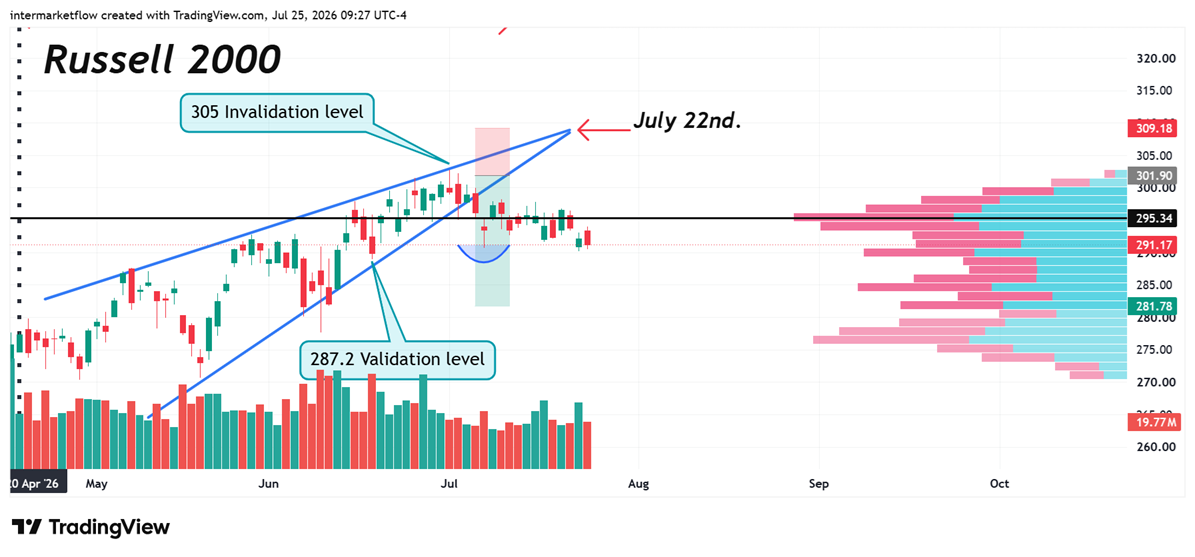
This chart was sent months ago.
- High Grade bonds: the deepest structural weakness within credit.
- Junk Bonds: the clearest vehicle for monitoring accelerating marginal credit stress.
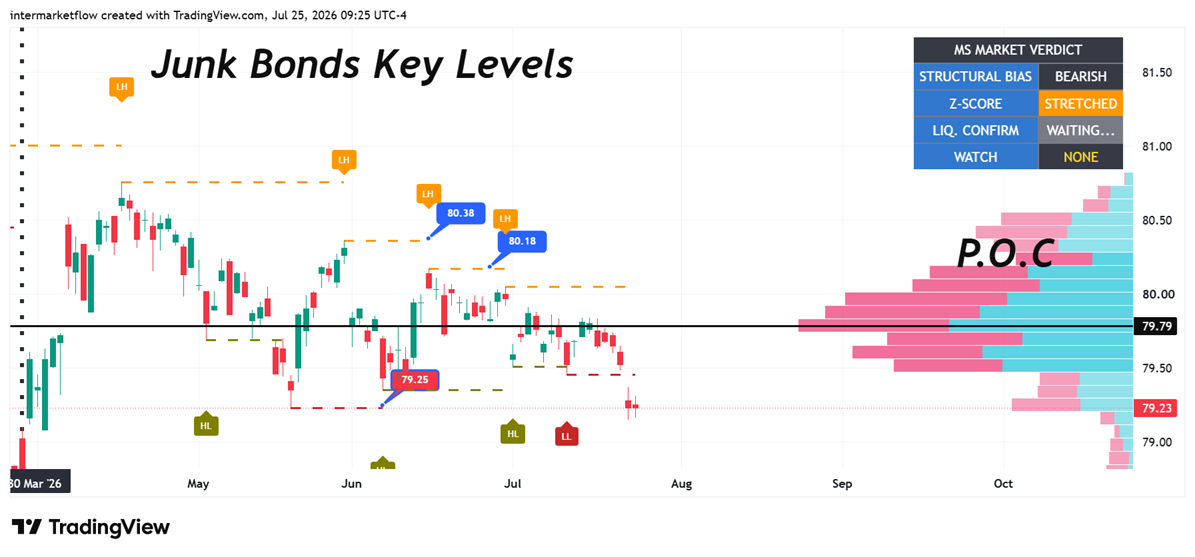
This chart was sent months ago.
- U.S. dollar: the strongest relative defensive vehicle.
- Gold: resilient, but still lacking participation confirmation.
These are not isolated trades. They are the assets most clearly expressing the current intermarket structure.
What Changes the Regime and what to expect
- The bearish structure remains intact while equities and credit stay in Bear Confirmation.
- A further breakdown would require renewed deterioration in returns, persistent contraction in participation and a fresh expansion in volatility.
- Invalidation requires more than another rebound. It requires improving returns supported by expanding volume across equities and credit.
Until then, the market remains weak without panic, defensive without rotation and vulnerable without expensive protection.
Risk propension-Portfolio Managers-Traders
- From a risk-appetite perspective, this is not the time to add exposure.
- From a portfolio-management perspective, it is the time to renew or reinforce hedges while protection remains relatively cheap.
- For traders, the message is direct: this market should be traded from the short side—or not traded at all.
The Sunday Report identifies the regime and the vehicles expressing it. The Mid-Week Report determines whether credit, volatility and participation are confirming the next move—or invalidating the entire thesis.
- The edge is not seeing weakness after price breaks. It is knowing which confirmation must appear before the break begins.
Intermarket Flow
If you believe this is an error, please contact the administrator.